
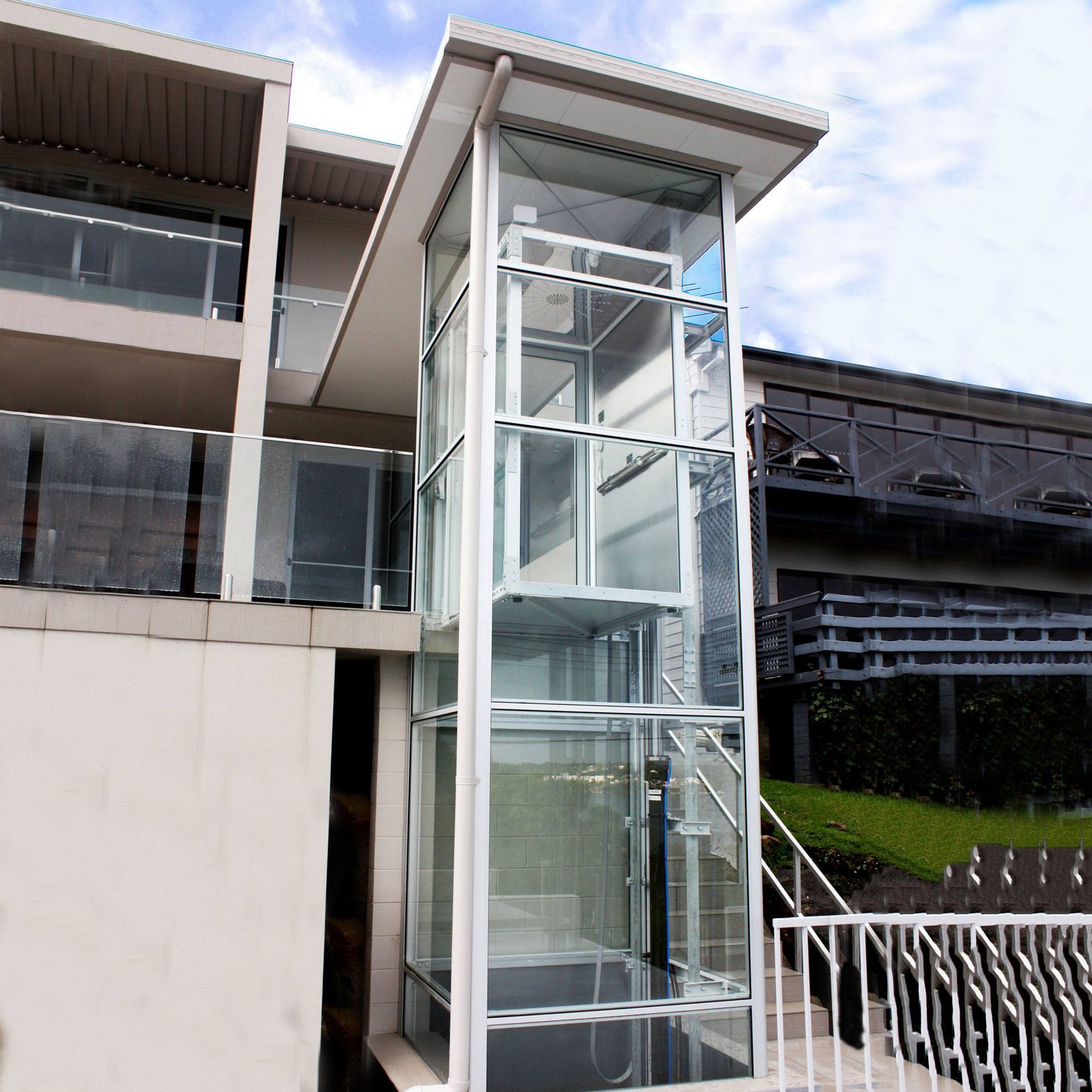
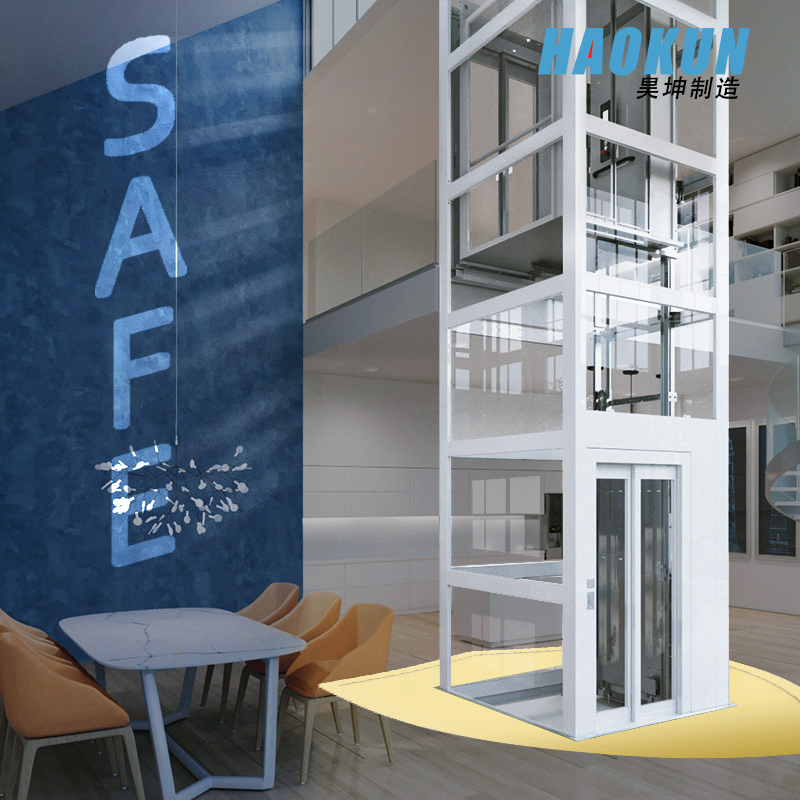
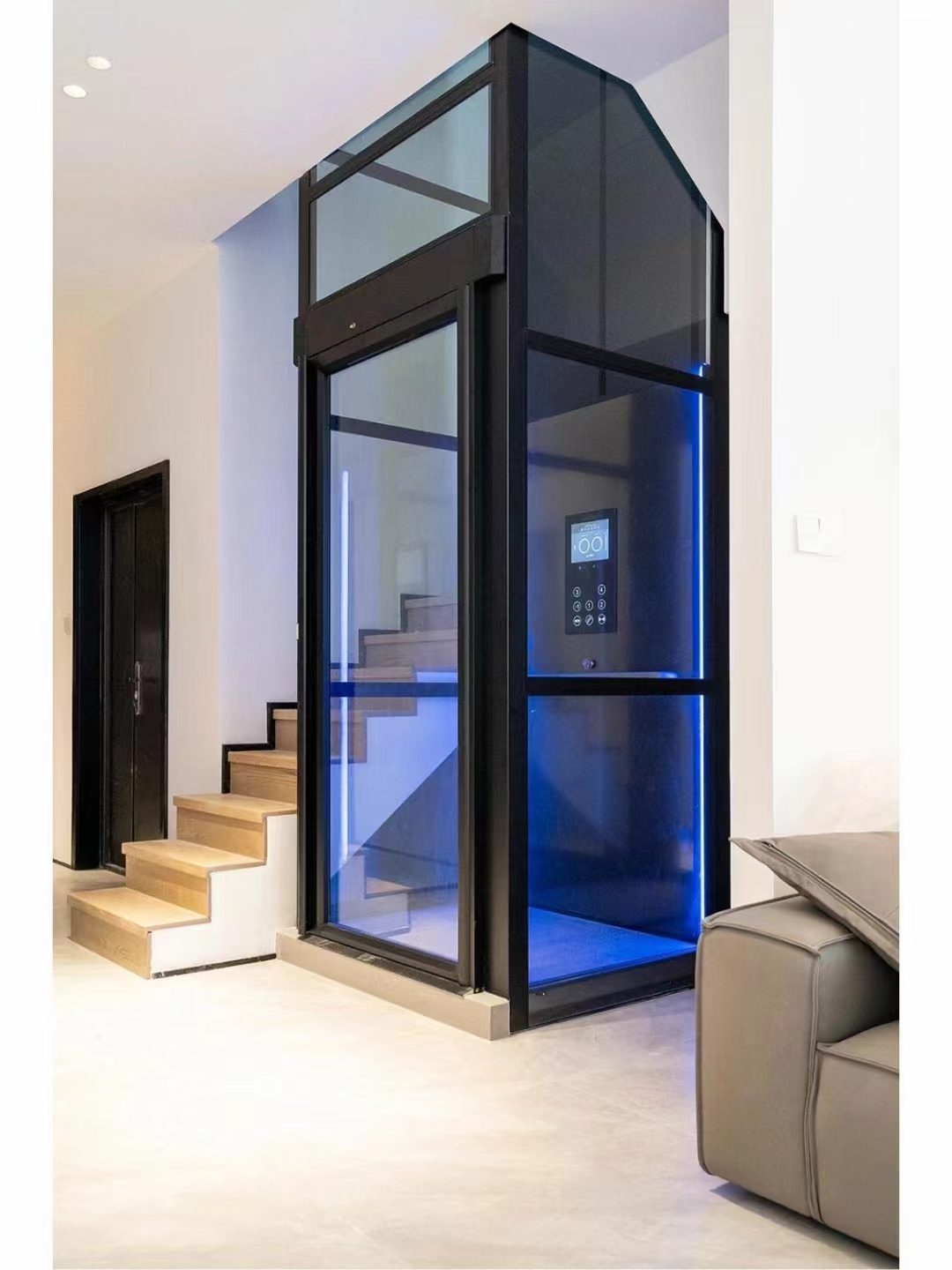
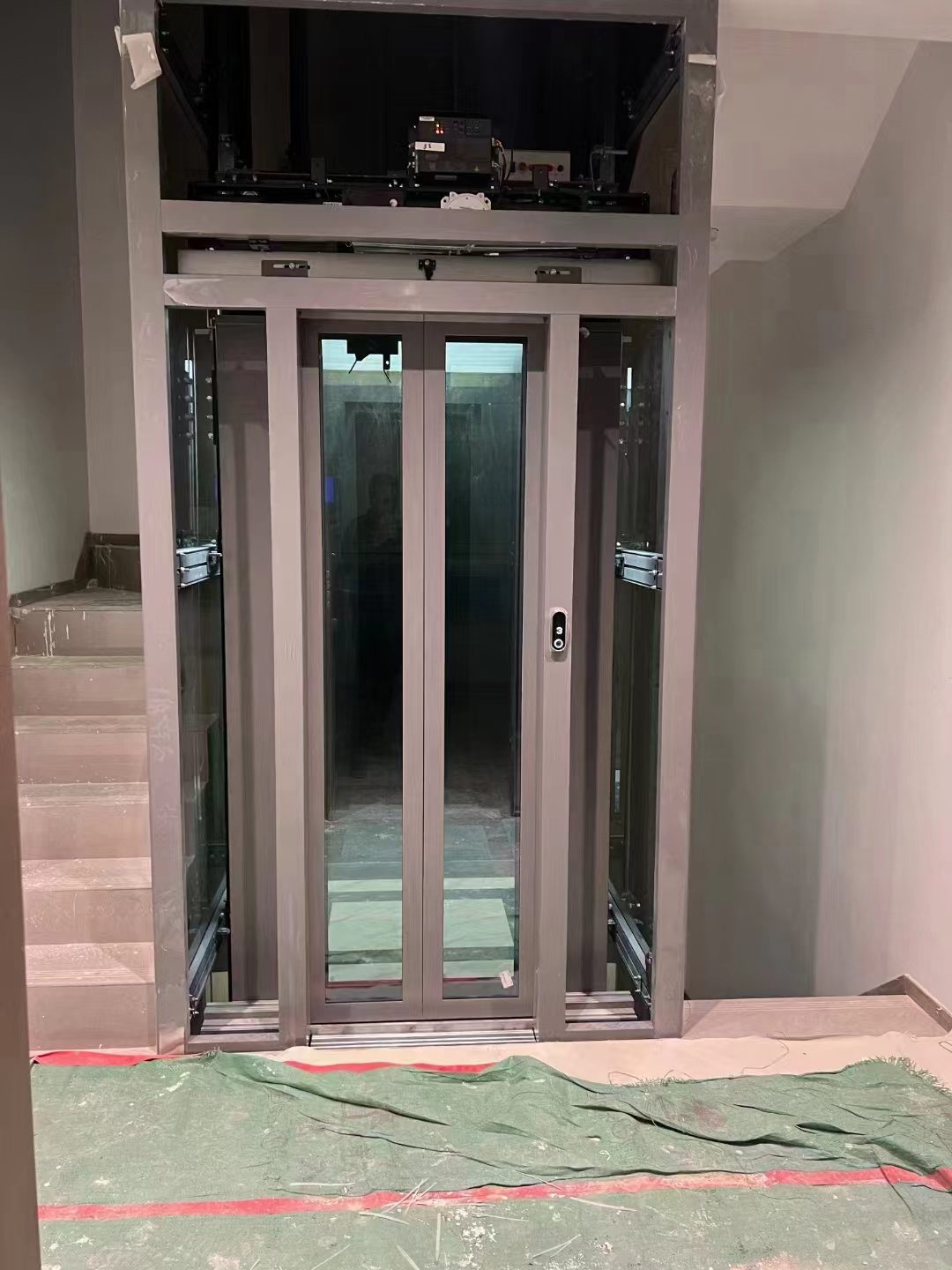
Choosing a home elevator is a big decision — and the very first choice you’ll face is the type of drive system. The two main options for modern homes are hydraulic and traction, each with its own strengths, ideal use cases, and price points. A third type, pneumatic (vacuum), also exists on the market — we introduce it in this guide for completeness, but we do not recommend it. Understanding how these systems differ helps you pick the one that best fits your home, your floors, and your budget.
This guide explains how each type works, who it suits best, and how to make the right choice.
1. The Main Types at a Glance
| Type | How It Works | Best For |
|---|---|---|
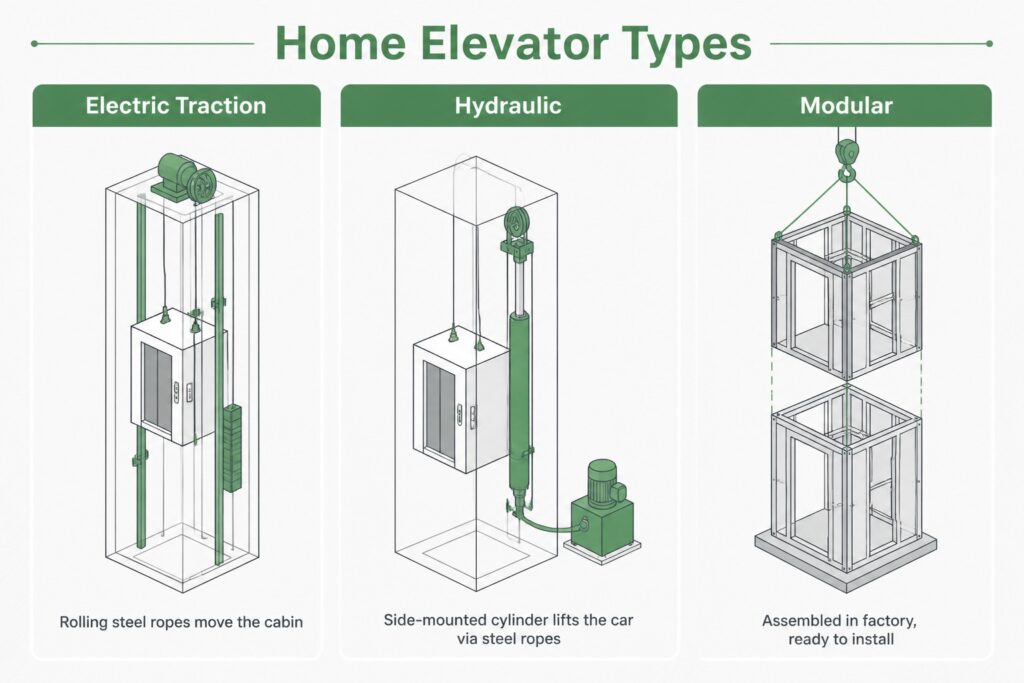
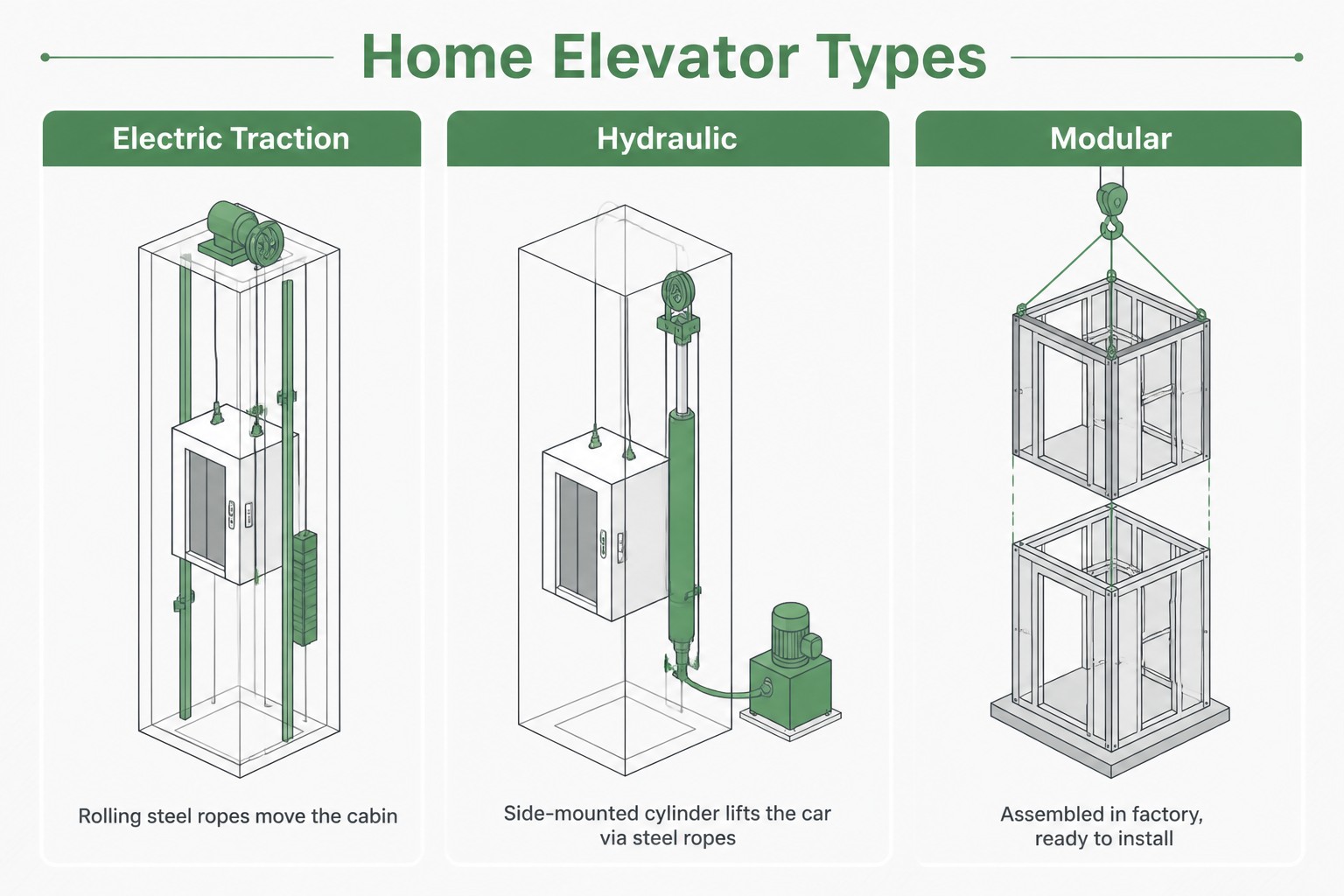
| Hydraulic | Side-mounted hydraulic cylinder lifts the car via steel ropes | 2–3 storey homes, budget-conscious buyers |
| Traction | Motor-driven sheave + steel ropes with counterweight | All home heights (2+ storeys), quality-focused buyers |
| Pneumatic (vacuum) | Air pressure difference moves the car in a self-supporting tube | Not recommended by HAOKUN — see Section 4 |
2. Hydraulic Elevators: The Economical Workhorse
How it works
A hydraulic elevator uses an electric pump to push oil into a cylinder mounted on one side of the shaft. The cylinder raises a system of steel ropes over a pulley, which lifts the car smoothly. To descend, a valve opens and the car lowers under control as the oil returns to the tank.
Best suited for
- 2–3 storey homes — the most common residential configuration
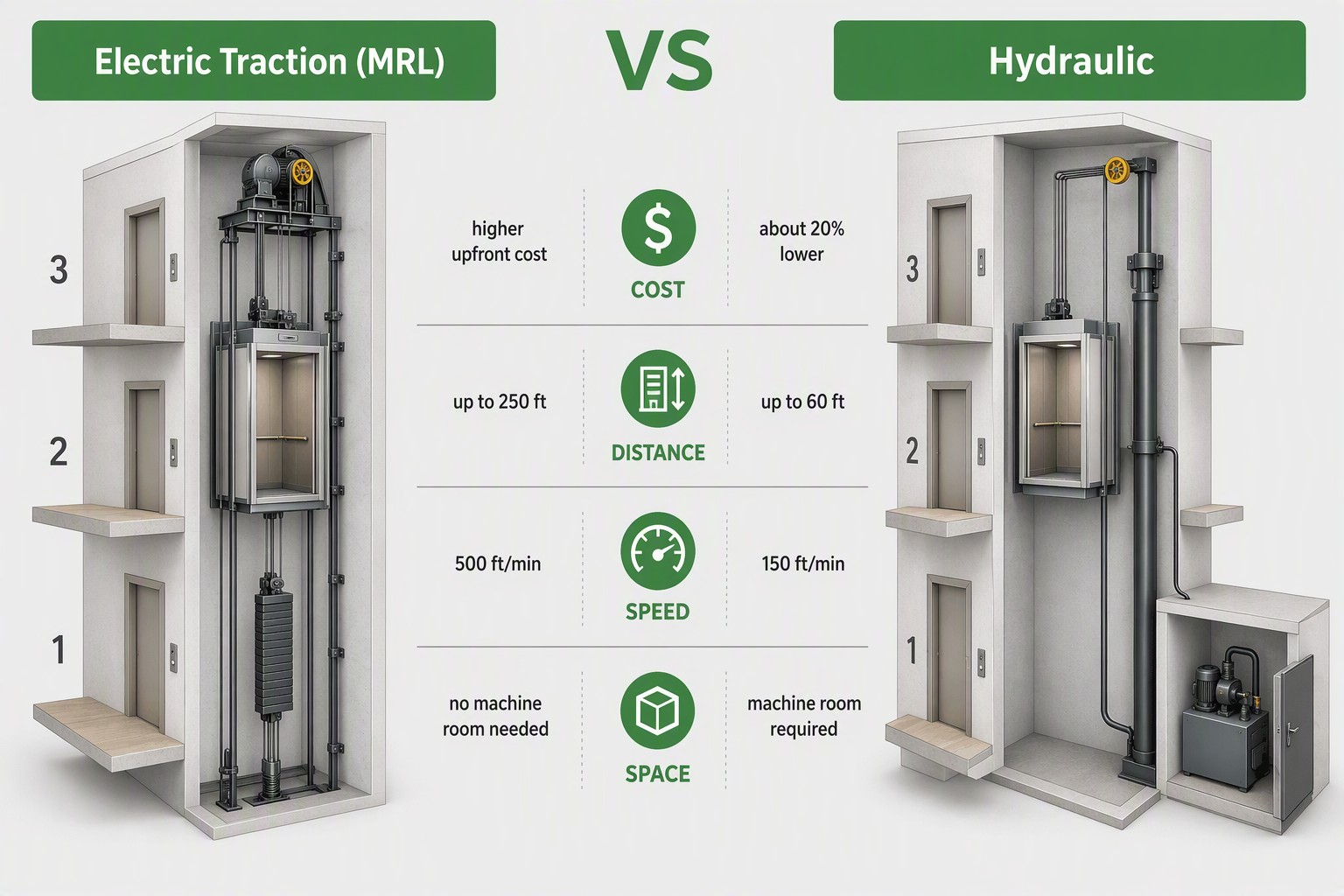
- Budget-conscious projects — the most affordable drive type, starting from $3,000
- Heavy loads — hydraulic systems handle substantial weight with ease
- Buyers who value proven, simple technology
Key points to know
- Requires a machine room (pump and oil tank), though compact units exist
- Compact footprint — HAOKUN’s side-mounted design fits into tight spaces, requiring as little as 1 m² of installation area
- No pit required — easy installation in existing homes without deep excavation
- Smooth, controlled movement with excellent load-holding capability
- The most widely used system in low-rise residential lifts worldwide
3. Traction Elevators: The Modern Standard
How it works
A traction elevator uses an electric motor to turn a grooved sheave. Steel ropes run over the sheave — one end holds the car, the other holds a counterweight. The counterweight balances most of the car’s weight, so the motor works less and the system runs efficiently.
Best suited for
- Quality-focused buyers — the premium choice for those who demand the highest quality, comfort, and a truly quiet ride
- All home heights, including 2-storey homes — works perfectly from 2 floors up, and handles taller lifts with ease and faster travel speeds
- Quiet operation — no noisy pump; the ride is smooth and hushed
- Low long-term maintenance — no oil to change, fewer wear-prone components
- Energy-conscious buyers — the counterweight design reduces motor load
Key points to know
- Excellent quietness — the quietest ride of any elevator type, ideal for bedrooms and living areas
- Starting from $8,500 — a higher initial investment with lower lifetime running costs
- Machine-room-less (MRL) versions eliminate the machine room entirely, saving space and construction cost
- Compact footprint — fits into spaces from as little as 1 m², with no pit required for easy installation
- Cheaper to maintain over time, quieter, and more durable than hydraulic systems
- Installation is straightforward — our elevators arrive factory pre-assembled, with most parts and guide rails already assembled to save you significant on-site time
4. Pneumatic (Vacuum) Elevators: What They Are — and Why We Don’t Recommend Them
For completeness, it’s worth knowing about the third type on the market, even though HAOKUN does not recommend it.
How it works
A pneumatic elevator moves inside a self-supporting tube using air pressure differences. It requires no pit, no shaft, no machine room — the tube itself is the structure, which is why it is sometimes marketed as the “plug-and-play” option.
Characteristics
- No shaft or machine room needed — the self-supporting tube is the whole structure
- Simplest installation — minimal structural work required
- Compact design — cabin sizes are noticeably smaller than traditional elevators
- Higher unit price — typically $35,000–$80,000+
- Moderate–high noise — the vacuum/air system is noticeably louder than traction
- Limited travel distance — typically suited to short 2–3 stop installations
Why HAOKUN does not recommend pneumatic elevators
- Cost vs. value — you pay a premium price for a smaller cabin than hydraulic or traction systems at a comparable budget
- Cabin space — the compact round/oval tube design limits usable interior space, which matters for wheelchair users or moving furniture
- Noise — noticeably noisier than traction systems during operation
- Service dependency — pneumatic systems rely on proprietary components and specialized technicians; maintenance and spare parts are typically tied to the original brand, which can complicate long-term servicing, especially for imported units
- Proven alternatives exist — for any home where a shaft can be accommodated, hydraulic or traction delivers better space, value, and long-term reliability
> Bottom line: pneumatic elevators solve the “no shaft” problem, but for the same money, hydraulic and traction systems give you more cabin space, quieter rides, and easier long-term maintenance. That is why HAOKUN manufactures and recommends only hydraulic and traction systems.
5. Side-by-Side Comparison
| Factor | Hydraulic | Traction | Pneumatic* |
|---|---|---|---|
| Ideal floors | 2–3 | 2+ (all home heights) | 2–3 |
| Starting price | from $3,000 | from $8,500 | $35,000+ |
| Machine room | Required | Optional (MRL available) | Not required |
| Shaft needed | Yes | Yes | No (self-supporting tube) |
| Min. space (HAOKUN) | from ~1 m², no pit | from ~1 m², no pit | — |
| Pit required (HAOKUN) | No | No | No |
| Noise level | Moderate (pump) | Low (quietest) | Moderate–high |
| Maintenance cost | Higher (oil changes, seals) | Lower | Moderate, brand-dependent |
| Energy efficiency | Moderate | High | Moderate |
| Durability | Good | Excellent | Good |
| Installation complexity | Moderate | Simple (factory pre-assembled) | Simplest |
| HAOKUN recommendation | Recommended | Recommended | Not recommended |
\Pneumatic is shown for comparison only. HAOKUN does not recommend pneumatic elevators — see Section 4 for details.*
6. How to Choose: A Simple Decision Guide
Ask yourself these questions in order:
Q1: How many floors?
- 2–3 floors → hydraulic (economical) or traction (premium)
- 3+ floors → traction (recommended; hydraulic is not recommended above 3 storeys due to higher failure rate and maintenance cost at taller lift heights)
Q2: Do you have space for a shaft and machine room?
- Yes → hydraulic or traction
- No machine room space → MRL traction model (pneumatic is available on the market, but we do not recommend it — see Section 4)
Q3: What matters more — upfront cost or long-term cost?
- Lower upfront cost → hydraulic (from $3,000)
- Lower lifetime cost, quietest ride, maximum reliability → traction (from $8,500)
Q4: How important is quietness and low maintenance?
- Very important → traction — it is the quietest, most durable, and cheapest to maintain over time
Quick recommendations
| Your situation | Recommended type |
|---|---|
| 2–3 storey home, tight budget | Hydraulic |
| Quality and quietness are top priorities | Traction |
| 2-storey home, premium choice | Traction |
| 3+ storey home | Traction (MRL) |
| Seniors aging in place, daily quiet use | Traction |
| Heavy goods, workshop or commercial light use | Hydraulic (2–3 storeys) |
7. Why Buyers Choose HAOKUN
HAOKUN manufactures and exports both hydraulic and traction drive units, plus enclosures from $200/m² in indoor and outdoor forms.
What you get with HAOKUN:
- Hydraulic drive units from $3,000 / traction from $8,500
- Compact installation — fits into spaces as little as 1 m², with no pit required
- Free 3D design drawings and customized solutions
- Factory pre-assembly — most parts and guide rails arrive already assembled for fast, simple installation
- Professional on-site installation guidance available (cost calculated per country)
- Full CE and ISO 9001 certification, complete export documentation
Whatever your floors, space, or budget — there is a home elevator type that fits. And with the right supplier, choosing and installing it is simpler than you think.
Ready to Find Your Type?
Contact the HAOKUN team with your number of floors, available space, and budget, and we’ll recommend the right drive system — with a detailed, itemized quotation within 24 hours.
Contact HAOKUN:
- Phone: +86 132 1058 1168
- Email: sales01@haokungroups.com
- Website: haokungroups.com